If you’ve ever overheard a teenager mutter “no cap, that’s mid frfr” and wondered whether it was English at all, you’re not alone. Gen Z- those born roughly between the late 1990s and early 2010s have developed a distinctive dialect shaped almost entirely by the internet.
From TikTok slang to Snapchat streaks and emoji-based storytelling, their communication reflects both the platforms they grew up with and the cultural shifts of a hyper-connected world.
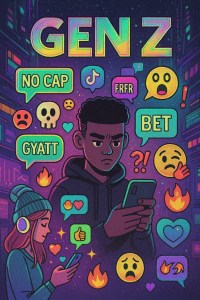
Here’s a closer look at the A–F of Gen Z communication.
- Core Digital Vocabulary
Every generation has its jargon, but Gen Z’s is deeply platform-specific.
- DM (Direct Message): The private channel where much of Gen Z life happens, from casual chats to confessions.
- FYP (For You Page): TikTok’s personalised feed is the holy grail for creators hoping to go viral.
- Main / Spam / Finsta: Identity is carefully curated. The “main” account is public-facing and polished, the “spam” or “finsta” is raw, unfiltered, and shared with only trusted friends.
- Soft Block: A digital form of social distancing: blocking then unblocking someone so they’re quietly removed as a follower.
- Stan: To be an intensely loyal fan, a word borrowed from Eminem’s 2000 hit Stan but reborn as a badge of online devotion.
- Ratio: On X (formerly Twitter), being “ratioed” when replies outnumber likes is often shorthand for public disapproval.
These terms are not fringe. They’ve become everyday shorthand for how young people define relationships, status, and belonging in digital spaces.

- Slang & Tone Indicators
Gen Z slang moves quickly, powered by TikTok trends, viral sounds, and memes. But some expressions have proven resilient:
- “No cap” means “I’m serious.”
- “FR” or “FRFR” = “For real” (emphasis included).
- “Bet” can mean “yes,” “okay,” or “watch me prove you wrong.”
- “Lowkey” implies something said quietly or secretly; “highkey” is its louder sibling.
- “Dead” or 💀 signals laughter so strong it’s metaphorical death.
Tone indicators are another crucial layer. In a world of text-based communication, context matters:
- /j = joking
- /srs = serious
- /p = platonic
- /gen = genuine
So a message like, “You’re literally the worst /j” makes clear it’s banter, not bullying.
- Social Media Behaviours
It’s not just what Gen Z say, but how they behave online that defines their generation.
- Ghosting: Cutting off communication with no explanation — common in dating, friendships, even jobs.
- Lurking: Watching silently without commenting or posting.
- Clout: Online popularity, whether earned or engineered.
- Cancel Culture: Collective online backlash against individuals or brands who misstep.
- Soft Launch vs Hard Launch: Introducing a partner subtly (a cropped hand photo) versus officially (a full couple selfie).
- -core aesthetics: From “cottagecore” to “goblincore,” niche aesthetics offer micro-identities and communities.
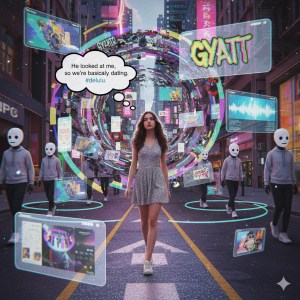
A single thought bubble cuts through the noise of a neon-drenched future: “He looked at me, so we’re basically dating. #delulu.” This digital artwork captures the intersection of internet slang and a dystopian cyberpunk setting, illustrating how modern obsessions thrive even in a hyper-connected world
These behaviours reflect an environment where visibility, reputation, and belonging are constantly negotiated.
- Memetic & Humour Styles
If Millennial humour was defined by sarcasm, Gen Z’s is shaped by absurdity and self-awareness.
- Sh*tposting: Deliberately chaotic, low-effort content meant to entertain.
- Main Character Energy: Acting as if your life is a cinematic story, soundtrack included.
- Delulu: Lighthearted delusion “He looked at me, so we’re basically dating.”
- NPC: Someone perceived as background, predictable, or robotic, like a non-playable video game character.
- Gyatt: An exclamation of surprise, often exaggerated.
This humour is layered, self-referential, and thrives in short-form formats like TikTok edits or meme templates.
- Daily Life & Digital Routines
Digital habits bleed into offline routines.
- Snapchat Streaks: Daily exchanges of snaps become a measure of friendship commitment.
- Doomscrolling: Endless scrolling through negative news or content late at night.
- Brainrot: Consuming repetitive or nonsensical content that’s addictive despite lacking value.
- Touch Grass: A reminder to disconnect, go outside, and engage with real life.
- Hot Girl Walk: A popularised wellness trend walking while listening to music or affirmations, framed as an act of empowerment.
- Side Eye: Both a look and an emoji shorthand (🫣 or 🤨) for silent judgment.
What looks trivial is often ritual. These habits structure Gen Z’s social connections, self-care, and daily rhythms.
- Emoji & Visual Communication
For Gen Z, emojis aren’t decorative, they’re essential grammar.
- 💀 / ☠️: “I’m dead” = extreme laughter.
- 😭: Used for laughing, not crying.
- 👀: “I’m watching” or “that’s suspicious.”
- 🔥: Approval, hype, admiration.
- ✨Word✨: Ironic emphasis, often mocking motivational clichés.
- 🫶: A relatively new “love” or appreciation gesture.
- 🫠: The melting face = embarrassment, awkwardness, or being overwhelmed.
Each emoji carries layers of meaning, depending on context. A simple “😭” in a chat can signal shared humour more strongly than words.
More Than Just Slang
Critics often dismiss Gen Z’s language as fleeting or frivolous. But like every generation before them, they are shaping identity, humour, and community through words. The difference? Their lexicon is built in real-time, online, across global networks.
To older eyes, it might look like “brainrot.” To Gen Z, it’s simply the language of living in an always-online world. Or, as they’d put it: IYKYK.